One Listing, Five Moments: What a Better Listing Experience Should Handle
A better listing experience helps a Tulsa realtor launch, answer, capture, report, and improve without replacing the MLS or the agent.
Research and drafting were assisted by the Oklahoma AI Works Content agent. Jason reviewed the sources, claims, and final copy before publication.
Most listing technology is organized around systems.
There is the brokerage website. The MLS. A showing service. A CRM. A 3D-tour host. Social channels. Email. A seller report. Each tool has a job, but the buyer or seller rarely experiences the tools as a neat stack.
They experience moments.
A seller sees how the home is launched. A buyer explores the property after dinner. A question turns into an inquiry. The agent has to explain activity without exaggerating it. Then the next week, or the next listing, should work a little better.
That is the idea behind The Listing Desk:
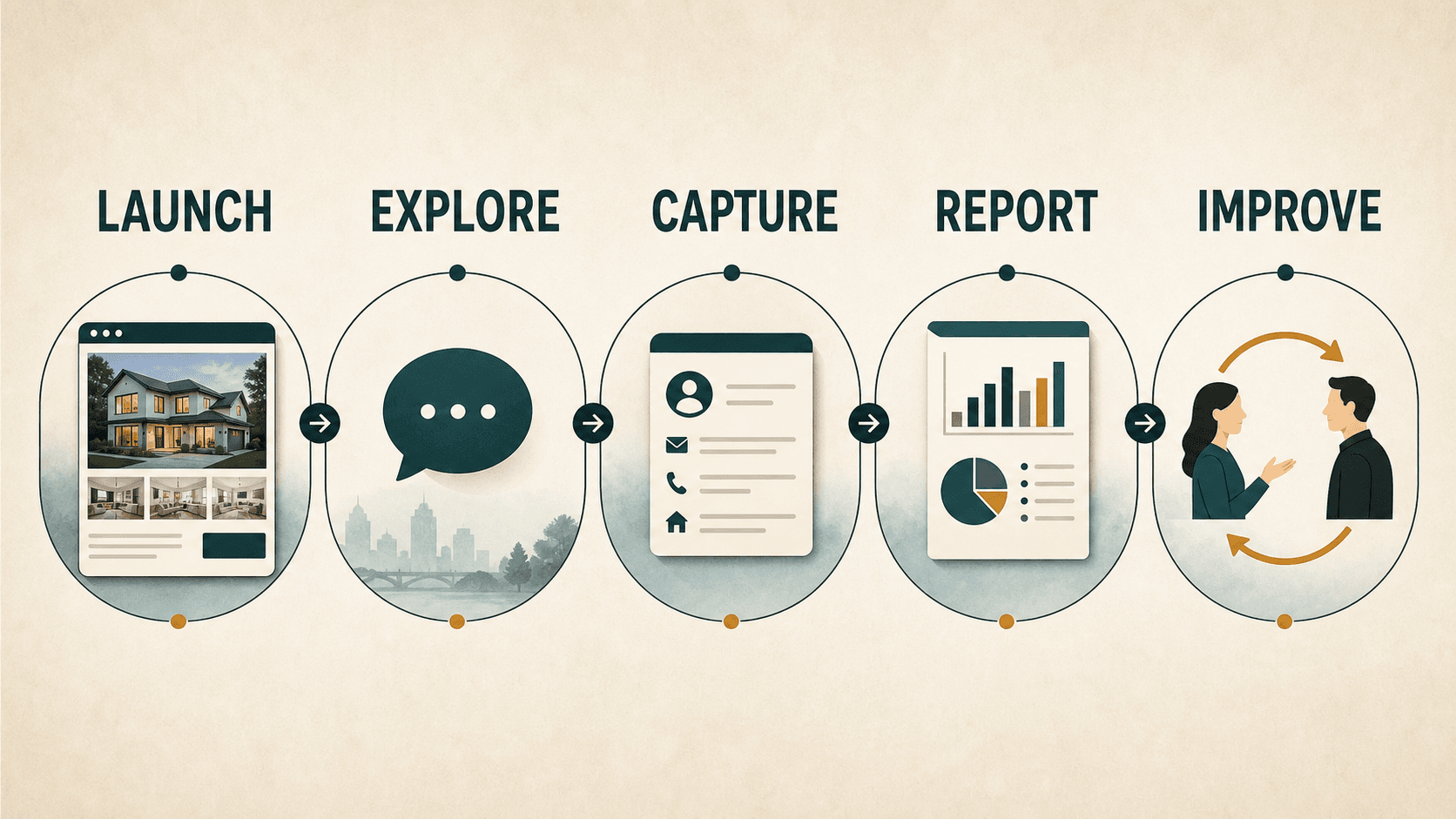
One listing. Five moments handled.
The five moments are Launch, Explore, Capture, Report, and Improve. They are not a replacement for the MLS, the brokerage, or the realtor. They are a way to make the experience surrounding the agent's own listings more coherent.
1. Launch: turn the approved packet into a complete story
A listing page should do more than repeat a small set of fields.
The launch moment begins with the material the agent and broker have approved:
- professional photography;
- property description;
- structured facts and features;
- floor plan;
- approved documents;
- open-house and showing paths;
- embedded video or 3D tour;
- brokerage identity and required disclosures; and
- the agent's own explanation of what matters about the property.
The public page should make those pieces easy to scan without pretending to be an IDX portal. The Listing Desk is deliberately narrower. It presents the agent's approved listings rather than trying to become a general home-search database.
Oklahoma's advertising rules require accurate property information, broker identity, and authorization before a property is advertised. That makes the approved packet more than a content convenience. It is the source boundary for the entire experience.
2. Explore: answer approved questions after hours
People do not stop thinking about a home when the office closes.
They may return to a floor plan, compare room details, check an improvement date, or wonder whether an item is included. A property-specific Listing Guide could answer those questions from the approved packet and show where the answer came from.
The important word is "approved."
The guide should not estimate value, interpret disclosures, recommend a neighborhood, discuss seller motivation, expose private showing information, or improvise when the source is silent. Those questions belong with the realtor or another licensed professional.
The explore moment works when it reduces routine repetition without separating the consumer from the human relationship.
3. Capture: turn interest into an organized inquiry
A contact form usually collects a name, email, and message. That is enough to create another inbox item. It is not always enough to create a useful handoff.
A better inquiry can collect:
- the property;
- the question or request;
- preferred contact method;
- preferred timing;
- whether the person is already represented; and
- consent for the specific follow-up being requested.
That information should go into the agent's existing workflow, not a new shadow CRM.
The capture moment is also where restraint matters. An inquiry is not permission for an endless campaign. A showing request is not permission for unrelated marketing. Representation status is not a field for the software to judge. The system organizes the facts, then a person makes the professional decision.
4. Report: give the seller evidence without fake certainty
Raw analytics are easy to produce and easy to overstate.
Page views do not prove buyer intent. A chat session is not a lead unless the visitor takes a meaningful next step. A spike in traffic does not prove the marketing caused an offer.
A useful Seller Brief should separate three things:
- Activity: page visits, media interactions, Listing Guide conversations, and inquiries.
- Questions: what prospective buyers repeatedly asked.
- Action: what the agent changed or plans to do next.
The report should label estimates, exclude internal or obvious test traffic where possible, and avoid causal claims the data cannot support.
The seller does not need an analytics dashboard tour. The seller needs a calm explanation of what happened, what the agent learned, and what comes next.
5. Improve: use real questions to make the experience better
The final moment is the one most website projects miss.
If visitors repeatedly ask whether there is a first-floor office, that detail may need to be clearer on the page. If a document is hard to find, move it. If the Listing Guide refuses a legitimate question because the approved packet lacks the answer, the agent can decide whether to add a reviewed fact.
Improvement should be small and observable:
- clarify one feature;
- add one approved answer;
- correct one confusing path;
- update one outdated instruction;
- tighten one escalation rule.
The system becomes more valuable when someone is responsible for that loop. Local accountability is not a support add-on. It is part of the product.
What the five moments do not include
The Listing Desk concept does not promise:
- IDX search;
- MLS scraping;
- automated valuation;
- contract, disclosure, inspection, lending, or negotiation advice;
- autonomous lead nurture;
- a replacement CRM;
- fabricated engagement numbers; or
- a generic AI trained on unapproved listing content.
The purpose is not to own every system. It is to connect the public listing experience to an organized, human-controlled workflow.
Start with one real listing
The five-moment model is useful because it can be tested against a real process.
What arrives in the listing packet? Which questions repeat? How are showing requests handled today? What does the seller ask for each week? Which tools must remain in place? What would make the next listing easier to run?
Those questions are more valuable than a long feature list.
If you are rethinking the experience around your own listings, start with one real workflow. The Listing Desk is an invitation-only Tulsa design partnership from Oklahoma AI Works.
Sources
- Oklahoma Real Estate Commission advertising rule 605:10-9-4 (opens in a new tab)
- NAR Internet Advertising Policy (opens in a new tab)
- Tulsa REALTORS member technology overview (opens in a new tab)
docs/specs/12_listing_desk_pilot.md, Sections 1 through 7https://tulsaaiworks.com, public offer and current truth boundaries