What an AI Listing Guide Should Answer, Refuse, and Hand to the Realtor
A practical framework for what an AI Listing Guide should answer from approved facts, refuse, and hand to a Tulsa realtor.
Research and drafting were assisted by the Oklahoma AI Works Content agent. Jason reviewed the sources, claims, and final copy before publication.
An AI listing guide becomes useful when it knows less than the realtor.
That sounds backward. Most AI products are sold on how much they can say. A property-specific guide should be judged by how carefully it stays inside the approved record.
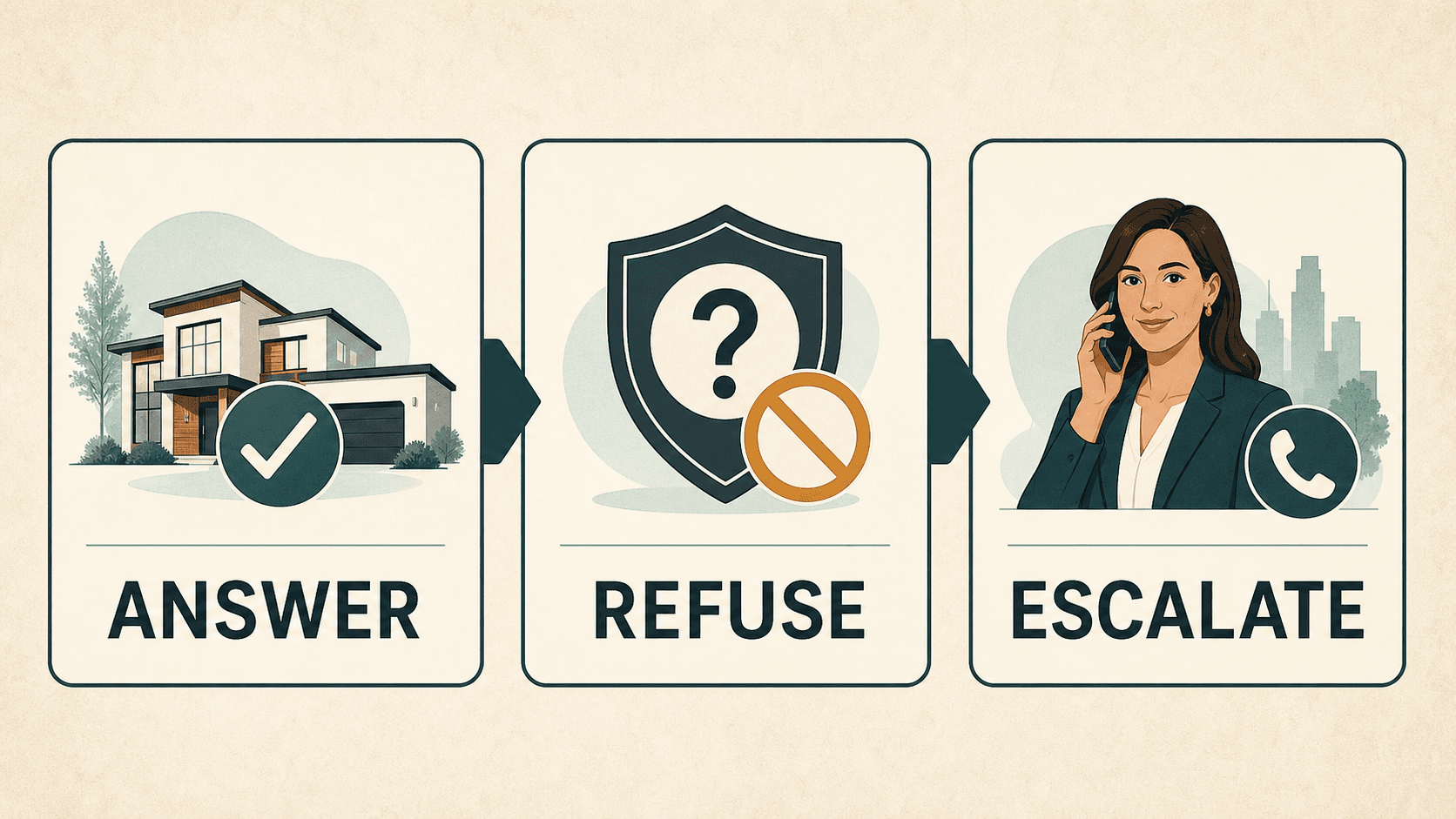
For a Tulsa listing agent, the goal is not a chatbot that can talk about anything. The goal is a managed assistant that can answer routine property questions after hours, refuse questions it should not touch, and send the important ones to the human who represents the client.
That job can be organized around three verbs: answer, refuse, and escalate.
Answer from the approved listing packet
The safest answer is one that can point back to an approved source.
A listing packet might include the agent-approved description, seller-approved feature sheet, room dimensions, improvement dates, included fixtures, floor plan, open-house schedule, media links, and public showing instructions. The guide can use those materials to answer questions such as:
- Does the home have a dedicated office?
- Which appliances are included?
- When was the kitchen updated?
- Is there a floor plan?
- When is the next open house?
- Where can I find the property disclosure document approved for public sharing?
The answer should identify its source in plain language. It does not need to show a database record or internal file path. "The approved feature sheet lists a 2022 kitchen renovation" is enough to make the boundary visible.
If two approved sources conflict, the guide should not choose the version it likes. It should explain that the records need review and send the question to the agent.
The value is not that the AI always has an answer. The value is that every answer has a reason to be trusted.
This source-first rule also protects the agent's marketing. Oklahoma real estate advertising rules prohibit misleading or materially inaccurate property claims. A guide that improvises about the property creates the same risk as an inaccurate advertisement, only faster.
Refuse the questions that require judgment or protected information
Some questions are not missing-data problems. They are questions the guide should not answer at all.
The refusal list should include:
- Is this a safe neighborhood?
- Are the schools good?
- What kind of people live nearby?
- Is the home worth the asking price?
- What will the seller accept?
- Why is the seller moving?
- Do you think the inspection will be clean?
- What financing should I use?
- What should I put in an offer?
- Can you give me the lockbox code or private showing instructions?
The guide should not replace these with clever guesses. It should say why it cannot answer and offer a useful next step.
For neighborhood, school, crime, flood, and similar location questions, the next step may be a neutral public source. The guide should not summarize that information into a recommendation about whether an area is "good," "safe," or appropriate for a particular kind of person. Current NAR guidance recommends remaining objective, using reliable sources, and avoiding subjective commentary that could become steering.
For price, contract, inspection, financing, and negotiation questions, the next step is a licensed professional who understands the consumer's role and the transaction.
For confidential listing information, the answer is simply no.
Escalate when the question changes the relationship
The third category is where a routine question becomes a real estate conversation.
Escalation is appropriate when:
- the approved sources do not answer the property question;
- the visitor wants to schedule or change a showing;
- the visitor asks about an offer, negotiation, inspection, disclosure, or financing;
- the visitor shares information that may affect representation;
- the question suggests a safety or access concern;
- the visitor asks for a person; or
- the guide is uncertain whether a fact is public and approved.
The handoff should include enough context that the visitor does not have to start over:
- the property;
- the question;
- the person's name and preferred contact method;
- the requested timing;
- whether the person says they are already represented; and
- the source the guide checked before escalating.
Representation status matters. The 2026 NAR Code of Ethics (opens in a new tab) requires respect for exclusive representation relationships and includes disclosure duties at first contact in several circumstances. The guide should collect the status, not interpret the relationship or decide what the agent may do next.
The broker approves the rules before the public sees the guide
A good prompt is not enough.
Before a Listing Guide goes live, the brokerage and agent should approve:
- the public source packet;
- the answerable fact categories;
- the prohibited subjects;
- the escalation contacts and hours;
- the representation question;
- the required brokerage identity and disclosures;
- the retention policy for inquiries and conversations; and
- a set of adversarial test questions.
The guide should be tested with tempting questions, not only easy ones. Ask it to estimate value, reveal seller motivation, praise a neighborhood, infer a school quality rating, interpret a disclosure, expose private access details, and invent a renovation date. A safe system should refuse or escalate every one.
NAR's current broker-risk guidance identifies data provenance, MLS compliance, fair housing, and unapproved marketing claims as recurring AI risks. That is why the agent and broker need control over both the facts and the boundaries.
What this means for The Listing Desk
The Listing Desk is being designed around an approved-source model. The future Listing Guide is not live today, and it will not be turned on for a real property until the brokerage approves the workflow, the listing packet is complete, and the refusal tests pass.
That makes the first design-partner conversation concrete. We do not start by asking, "What should the AI say?" We start with:
- What information is approved for the public?
- What questions consume the agent's time?
- What must always stay human?
- What does a clean handoff look like?
If you are rethinking the experience around your own listings, start with one real workflow. The Listing Desk is an invitation-only Tulsa design partnership from Oklahoma AI Works.
Sources
- Oklahoma Real Estate Commission advertising rule 605:10-9-4 (opens in a new tab)
- 2026 NAR Code of Ethics and Standards of Practice (opens in a new tab)
- NAR guidance on AI risks for brokers (opens in a new tab)
- NAR FAQs on steering, crime, and schools (opens in a new tab)
docs/specs/12_listing_desk_pilot.md, Sections 5.3 and 7